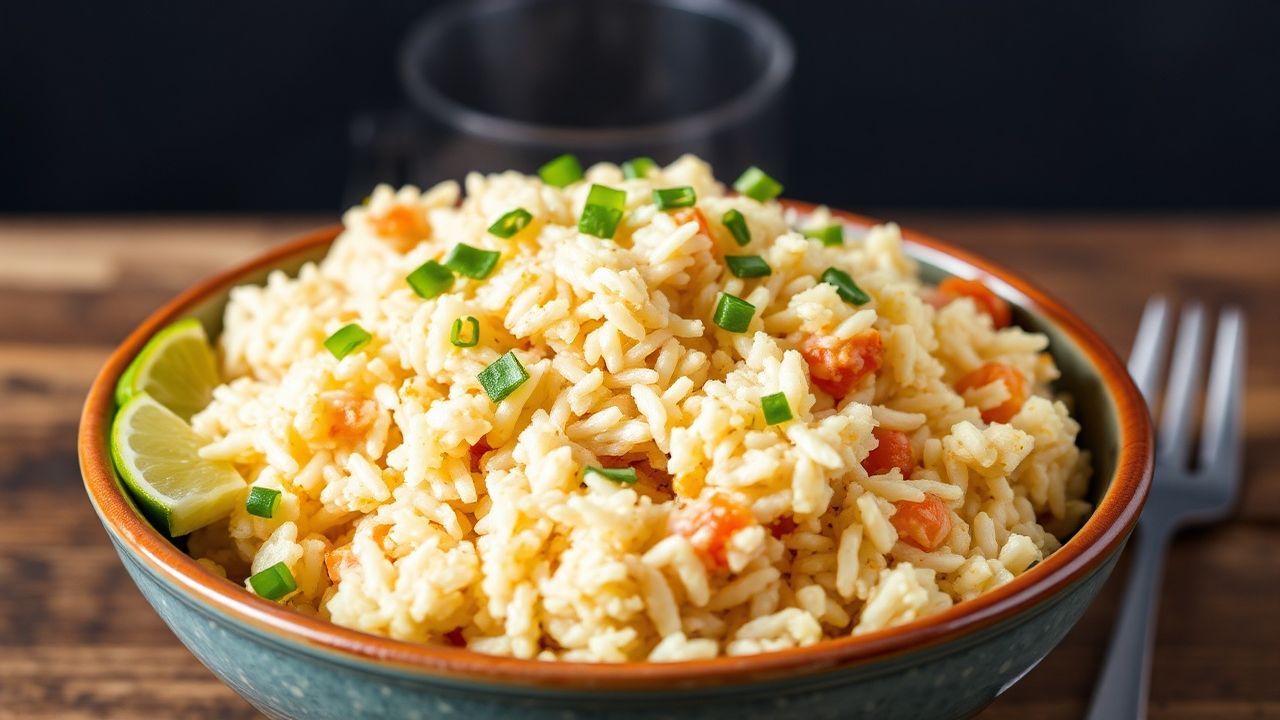

The 20-Minute Chicken Fried Rice: Mastering Speed and Flavor
There are few dishes that embody the concept of comfort food quite like a steaming bowl of fried rice. It’s a culinary chameleon, adaptable to whatever languishes in the refrigerator, and proof of the magic of transforming humble leftovers into something extraordinary. Yet, for many, achieving that elusive balance of tender chicken, perfectly separated grains of rice, and that unmistakable wok-kissed aroma often feels like a distant dream, especially when time is a luxury. I recall a particularly frantic Tuesday evening; the kind where the clock seemed to mock my culinary aspirations. A long day at the office had left me staring into the abyss of a nearly bare pantry, with a rumbling stomach and the distinct craving for something satisfying. The thought of a lengthy cooking process was frankly, out of the question. It was in that moment of desperation, a familiar yet often frustrating one for busy home cooks, that the idea for a truly rapid, yet uncompromised, chicken fried rice took root. This isn’t about shortcuts that sacrifice quality; it’s about understanding the fundamental principles of *wok hei* and ingredient preparation to deliver a phenomenal dish in under twenty minutes. The quest for the perfect 20-minute chicken fried rice is not merely a recipe, but a philosophy of efficient, flavorful cooking.
- The 20-Minute Chicken Fried Rice: Mastering Speed and Flavor
- The Foundation: Why Day-Old Rice Reigns Supreme
- Essential Ingredients for Speed and Flavor
- The Blitz: Mastering the 20-Minute Cooking Process
- Nutritional Snapshot: A Balanced Quick Meal
- Elevating Your Fried Rice: Expert Pro-Tips
- Frequently Asked Questions
At a Glance: Key Takeaways for Speedy Fried Rice
- Strategic Prep is Paramount: Mise en place is non-negotiable for speed. Pre-chop aromatics, dice chicken, and have all sauces measured.
- Day-Old Rice is Your Ally: Cold, dry, day-old rice is essential for preventing mushy fried rice. Freshly cooked rice will clump.
- High Heat, Quick Cooking: A screaming hot wok or skillet is crucial for achieving that signature smoky flavor and tender-crisp vegetables.
- Sauce Harmony: A balanced sauce mixture, pre-combined, ensures even flavor distribution and avoids frantic seasoning mid-cook.
The allure of fried rice lies in its deceptive simplicity. It’s a dish that has traversed continents, evolving from its humble origins in China to become a global phenomenon. The concept of quickly stir-frying cooked rice with various ingredients is a cornerstone of many Asian cuisines. Achieving that authentic *wok hei*, the smoky, slightly charred flavor imparted by a seasoned wok over high heat, is the holy grail. For the home cook, replicating this often requires a powerful stove and a well-seasoned wok, but even with standard equipment, intelligent technique can get you remarkably close. The challenge, then, is to condense this process, typically requiring careful staging and timing, into a mere twenty minutes. This requires a strategic approach, transforming potential chaos into a symphony of controlled culinary action. It’s about preparation, precision, and understanding the physics of high-heat cooking.
The Foundation: Why Day-Old Rice Reigns Supreme
The single most critical element for successful fried rice, especially when aiming for speed, is the type of rice used. Freshly cooked rice, still steaming and moist, is the enemy of good fried rice. When subjected to the intense heat of the wok, its starches gelatinize, leading to a sticky, clumpy, and ultimately unappetizing result. This is a common pitfall for novice cooks and a primary reason why homemade fried rice often falls short of its restaurant counterparts. The solution is elegantly simple: day-old rice. Refrigeration causes the cooked rice grains to firm up and dry out slightly, a process that breaks down some of the surface starches. This allows each grain to remain distinct and absorb the flavors of the other ingredients without becoming mushy. If you’re planning to make fried rice, the best practice is to cook your rice the day before and refrigerate it, uncovered, to allow it to cool and dry further. For those who find themselves spontaneously craving fried rice and don’t have pre-cooked rice, a quick fix involves spreading freshly cooked, hot rice on a baking sheet and allowing it to cool rapidly in the freezer for about 15-20 minutes, stirring occasionally. This mimics the effect of day-old rice, though the texture might be slightly less ideal than truly aged rice.
Consider the science behind it: the moisture content in rice directly impacts its texture when stir-fried. Freshly cooked rice might have a moisture content of around 70-75%, whereas day-old, refrigerated rice can drop to 60-65%. This seemingly small difference is monumental when it comes to preventing sticking and ensuring fluffy, individual grains. The Maillard reaction, responsible for browning and complex flavors, occurs more efficiently on drier surfaces. This is why professional kitchens often use specially designed rice cookers that produce a drier final product, or employ methods to rapidly cool and dry their rice. My own culinary journey has been punctuated by countless bowls of subpar, gluey fried rice until I embraced the gospel of day-old rice. It’s a fundamental understanding that unlocks the door to superior texture and flavor, particularly when time is of the essence.
Essential Ingredients for Speed and Flavor
To achieve a truly satisfying chicken fried rice in 20 minutes, meticulous ingredient selection and preparation are paramount. This isn’t a dish where you can afford to be foraging for ingredients mid-cook. Every component must be ready to go. The foundation of our rapid fried rice begins with the protein. Boneless, skinless chicken thighs are often preferred for their superior flavor and moisture retention compared to breasts, but either will suffice. The key is to dice them into small, uniform pieces (about 1/2 inch or 1.5 cm) to ensure they cook through quickly and evenly. For the aromatic base, finely minced garlic and ginger are indispensable. A small amount of chili, like a bird’s eye or serrano, can add a welcome kick if desired, but is entirely optional. The vegetables should be quick-cooking and prepped for rapid incorporation. Frozen peas and diced carrots are excellent time-savers, as they are already blanched and uniformly cut. Fresh scallions, sliced thinly, add a vibrant freshness and oniony bite. A few eggs, whisked and ready, will be scrambled into the rice, adding richness and binding elements.
The sauce is where the magic truly happens, and for speed, it’s best to have it pre-mixed. A classic combination includes soy sauce (low-sodium is often preferred to control saltiness), a splash of sesame oil for its nutty aroma, a touch of oyster sauce for depth and umami, and a pinch of sugar to balance the saltiness. Some cooks also incorporate a small amount of Shaoxing wine, a Chinese rice wine, for added complexity. The exact ratios can be adjusted to personal preference, but a good starting point is typically 2 tablespoons soy sauce, 1 teaspoon sesame oil, 1 tablespoon oyster sauce, and 1/2 teaspoon sugar. This balanced elixir, ready to be poured in, ensures that every grain of rice and every morsel of chicken is infused with flavor without delay. The choice of oil is also important; a neutral, high-smoke-point oil like vegetable, canola, or peanut oil is ideal for achieving the high heat necessary for stir-frying without burning.
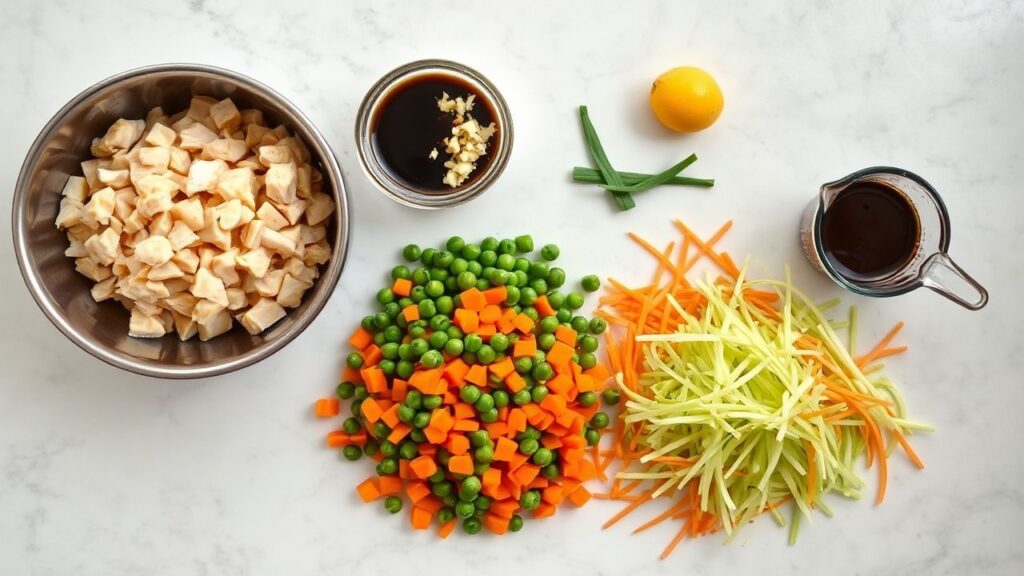
Ingredients:
- For the Chicken:
- 200g (about 7 oz) boneless, skinless chicken thighs or breasts, diced into 1/2-inch (1.5 cm) pieces
- 1 tablespoon soy sauce
- 1 teaspoon cornstarch
- For the Rice:
- 3 cups (about 500g) cooked, cold, day-old jasmine or long-grain white rice
- For the Sauce:
- 2 tablespoons soy sauce (low-sodium recommended)
- 1 tablespoon oyster sauce
- 1 teaspoon sesame oil
- 1/2 teaspoon sugar
- 2 tablespoons Shaoxing wine or dry sherry (optional)
- Aromatics and Vegetables:
- 2 tablespoons neutral cooking oil (e.g., vegetable, canola, peanut), divided
- 2 cloves garlic, minced
- 1 teaspoon grated fresh ginger
- 1/2 cup frozen peas and diced carrots (thawed slightly if frozen solid)
- 2 scallions, thinly sliced (white and green parts separated)
- For the Egg:
- 2 large eggs, lightly beaten
The Blitz: Mastering the 20-Minute Cooking Process
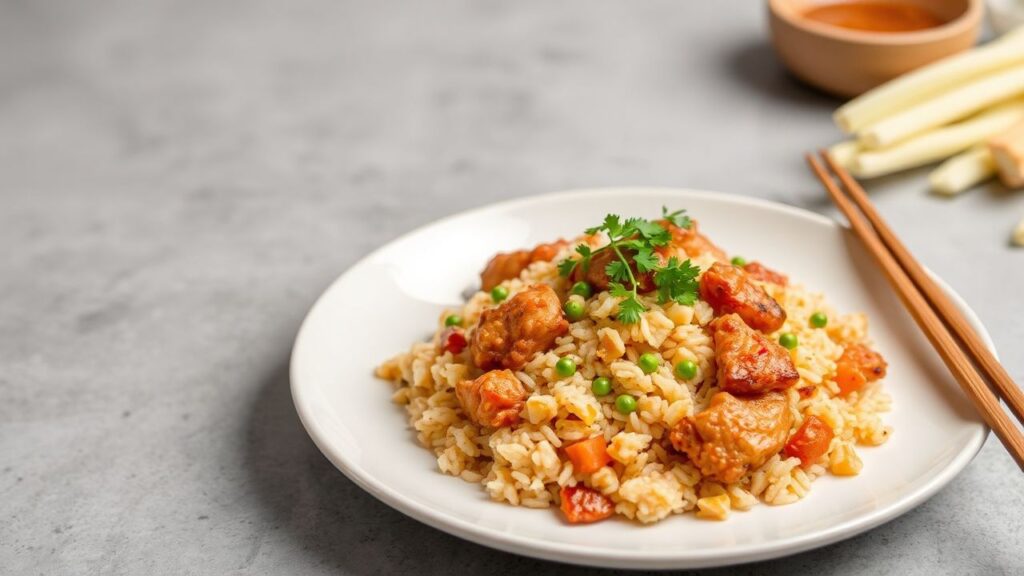
The cooking phase is a high-octane ballet of controlled chaos. Speed is of the essence, and efficiency is key. Begin by marinating the diced chicken. In a small bowl, toss the chicken pieces with 1 tablespoon of soy sauce and 1 teaspoon of cornstarch. The cornstarch helps to tenderize the chicken and creates a slight barrier that will help it brown beautifully. Let it sit for a few minutes while you prepare the wok. Next, ensure your sauce mixture is ready to go. Combine the soy sauce, oyster sauce, sesame oil, sugar, and optional Shaoxing wine in a small bowl and whisk until the sugar is dissolved. Have your whisked eggs and prepped aromatics and vegetables within arm’s reach. The entire cooking process should take no more than 10-12 minutes once the heat is on.
Heat a wok or a large, heavy-bottomed skillet over high heat until it begins to smoke. This is non-negotiable for achieving *wok hei*. Add 1 tablespoon of your neutral cooking oil, swirl to coat the pan, and then add the marinated chicken. Stir-fry the chicken rapidly for 2-3 minutes, or until it’s mostly cooked through and lightly browned. Remove the chicken from the wok and set it aside. This prevents it from overcooking while other ingredients are prepared. Now, add the remaining 1 tablespoon of oil to the wok. Add the minced garlic, grated ginger, and the white parts of the scallions. Stir-fry for about 15-20 seconds until fragrant, being careful not to burn the garlic. Immediately add the peas and carrots, stir-frying for another minute until they are heated through and slightly tender-crisp. Push the vegetables to the side of the wok, creating a well in the center. Pour the beaten eggs into the well and scramble them quickly until just set. Then, break up the scrambled egg and mix it with the vegetables.
Now, add the cold, day-old rice to the wok. Break up any clumps with your spatula. Stir-fry the rice, tossing it with the vegetables and egg, for about 2-3 minutes, allowing it to heat through and absorb some of the flavors. Return the cooked chicken to the wok. Pour the pre-mixed sauce evenly over the rice, chicken, and vegetables. Toss everything vigorously for another 2-3 minutes, ensuring the sauce coats every grain of rice and the ingredients are well combined. The goal here is to get a slight sizzle and char on the rice. Finally, stir in the green parts of the scallions. Taste and adjust seasoning if necessary, adding a touch more soy sauce if needed. Serve immediately in warm bowls.
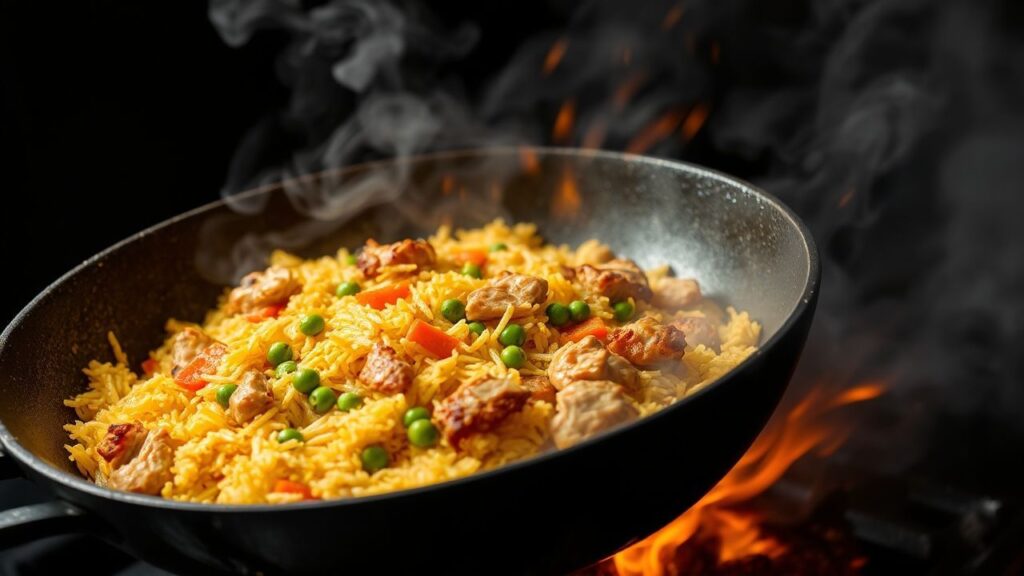
Nutritional Snapshot: A Balanced Quick Meal
While often perceived as mere comfort food, a well-prepared chicken fried rice can be a surprisingly balanced meal. The macronutrient profile will vary depending on the exact ingredients and portion sizes, but generally, it offers a good source of protein from the chicken and eggs, carbohydrates from the rice, and essential vitamins and minerals from the vegetables. A typical serving (approximately one-quarter of the recipe) can be estimated as follows:
| Nutrient | Approximate Amount (per serving) |
|---|---|
| Calories | 450-550 kcal |
| Protein | 25-30g |
| Carbohydrates | 50-60g |
| Fat | 15-20g |
| Fiber | 3-5g |
| Sodium | 800-1200mg (highly dependent on soy sauce and oyster sauce used) |
The sodium content can be significantly reduced by opting for low-sodium soy sauce and being mindful of the oyster sauce. The inclusion of lean protein and fiber from vegetables contributes to satiety, making it a satisfying meal that can fuel you through your day. For a healthier iteration, consider swapping half the white rice for brown rice, or increasing the ratio of vegetables. The key is moderation and smart ingredient choices. For instance, incorporating a wider array of colorful vegetables like bell peppers, broccoli florets, or snow peas can boost the micronutrient density. A research paper published in the *Journal of the American College of Nutrition* highlighted how incorporating diverse vegetables in stir-fries can significantly enhance antioxidant intake. This emphasizes that even quick meals can be powerhouses of nutrition.
Elevating Your Fried Rice: Expert Pro-Tips
Achieving restaurant-quality fried rice, even within a tight timeframe, is entirely possible with a few expert insights. The difference between a good fried rice and a great one often lies in the nuances of technique and ingredient handling. The concept of *wok hei* is paramount, and while a powerful gas burner and a well-seasoned carbon steel wok are ideal, you can approximate the effect on a standard stovetop. Ensure your pan is screaming hot before adding ingredients. This rapid searing is what creates those desirable crispy edges and smoky notes. Don’t overcrowd the pan; cook in batches if necessary to maintain high heat and allow for proper browning. This is a principle often overlooked by home cooks, leading to steaming rather than frying. For example, when cooking the chicken, if your pan isn’t large enough to accommodate it in a single layer without touching, cook it in two batches to ensure it browns properly. This attention to detail is what distinguishes truly exceptional fried rice.
Another critical tip is the strategic use of aromatics. Garlic and ginger are foundational, but their timing is crucial. Adding them too early will cause them to burn, imparting a bitter flavor. A quick sauté for 15-20 seconds until fragrant is all that’s needed before adding other ingredients. The texture of the vegetables also plays a role. Aim for tender-crisp rather than mushy. This means adding them towards the end of the cooking process, especially if using frozen vegetables that may release more moisture. The eggs, as mentioned, should be scrambled quickly and broken up, becoming integrated elements rather than distinct omelet strips. Finally, the seasoning should be applied judiciously and tasted before serving. A touch of white pepper, a staple in many Asian kitchens, can add a subtle warmth and complexity that elevates the overall flavor profile. Experimenting with different chili sauces or adding a dash of sriracha at the end can also introduce a personalized flair. For more inspiration on achieving authentic Asian flavors, explore resources like Wikipedia’s entry on the wok, which explore its historical significance and culinary applications.
The precise control of heat is perhaps the most defining characteristic of high-level stir-frying. Many home cooks err on the side of caution, using medium heat for fear of burning ingredients. However, the magic of *wok hei* is born from intense, direct heat. This high heat sears ingredients rapidly, creating a crisp exterior while keeping the interior tender and moist. It also allows for quick evaporation of moisture, preventing the dreaded soggy rice. When I first started experimenting with faster cooking methods, I noticed a significant improvement in texture and flavor simply by turning up the burner to its maximum setting and ensuring my wok was smoking before adding oil. This aggressive approach, when managed with swift stirring and precise timing, is what separates the quick-and-easy from the truly sublime. It’s a culinary dance that requires confidence and a keen awareness of the ingredients’ transformation.
Furthermore, the concept of *mise en place*—having all ingredients prepped and measured before cooking begins—is not merely a suggestion for speed; it’s an absolute necessity for successful stir-frying. In the intense heat of the wok, there is no time to chop an onion or measure out soy sauce. Everything must be within reach, ready to be added in the correct sequence. This forethought ensures that the cooking process flows smoothly and efficiently, allowing you to focus on the technique rather than the preparation. For instance, if you’re using fresh vegetables that require chopping, like bell peppers or broccoli, ensure they are cut into bite-sized, uniform pieces and are ready to go. A well-organized workspace is as crucial as a hot wok. For those looking to streamline their meal prep even further, consider investing in pre-cut frozen vegetables or even using pre-cooked chicken strips that can be quickly diced. These small efficiencies can shave precious minutes off your cooking time without compromising the final dish.
The integration of eggs into fried rice can be approached in several ways, each yielding a slightly different result. The method described above, scrambling them in the wok with the vegetables, ensures they are dispersed throughout the dish, adding richness and binding the components. Another popular technique involves cooking the eggs separately into a thin omelet, then slicing it and folding it into the rice at the very end. This creates distinct ribbons of egg throughout the fried rice, offering a different textural experience. For the 20-minute version, the scrambled-in-place method is generally faster and more efficient, ensuring the eggs are cooked through and integrated without adding extra steps or pans. Regardless of the method, the key is to cook the eggs quickly over high heat to prevent them from becoming rubbery.
Finally, the choice of rice is paramount. While jasmine rice is a popular and excellent choice, other long-grain varieties can also work. The crucial factor remains its state: cold and relatively dry. If you find yourself in a pinch and only have freshly cooked rice, a rapid cooling method is essential. Spreading it thinly on a baking sheet and placing it in the freezer for 15-20 minutes, stirring occasionally, can help to achieve the necessary dryness. Alternatively, some chefs advocate for rinsing freshly cooked rice under cold water and then draining it thoroughly to remove excess surface starch, though this can sometimes lead to a slightly less nuanced flavor profile compared to aged rice. The ultimate goal is to have individual, distinct grains that can absorb flavor without clumping into a dense mass. This foundational understanding of rice preparation is the bedrock upon which all great fried rice is built, especially when time is a constraint.
The sheer versatility of fried rice is one of its most enduring appeals. While this recipe focuses on chicken, the principles can be applied to a myriad of proteins and vegetables. Shrimp, pork, beef, tofu, or even just a medley of mushrooms and assorted vegetables can be substituted with minor adjustments to cooking times. For instance, if using shrimp, they cook very quickly and should be added towards the end of the stir-frying process to prevent them from becoming tough. Tofu, particularly firm or extra-firm varieties, can be pan-fried until golden brown before being added back to the wok, providing a satisfying textural contrast. The beauty of this 20-minute framework is its adaptability. It’s a template for quick, flavorful meals, perfect for those evenings when inspiration is low but hunger is high. The ability to transform simple ingredients into a delicious and satisfying dish in such a short span of time is proof of the power of efficient cooking techniques. It’s a culinary skill that pays dividends on busy weeknights, offering a reliable and delicious solution for a quick and wholesome meal.
Frequently Asked Questions
H3: What is the best way to prevent my fried rice from being sticky or clumpy?
The single most effective method is to use cold, day-old cooked rice. Freshly cooked rice contains too much moisture, causing its starches to gelatinize and stick together when stir-fried. Refrigeration dries out the rice grains, allowing them to remain distinct and absorb flavors better. If you don’t have day-old rice, spread freshly cooked rice on a baking sheet and cool it rapidly in the freezer for about 15-20 minutes, stirring occasionally. Ensure your wok or skillet is sufficiently hot before adding the rice, and break up any large clumps with your spatula as you stir-fry.
H3: Can I use other types of protein besides chicken?
Absolutely! Fried rice is incredibly versatile. Boneless, skinless chicken thighs or breasts are a classic choice, but you can easily substitute them with diced pork, thinly sliced beef, shrimp, or firm tofu. For faster-cooking proteins like shrimp or thinly sliced beef, adjust the cooking time accordingly, adding them towards the end of the stir-fry to prevent overcooking. If using tofu, pressing it to remove excess water and then pan-frying it until golden brown before adding it to the wok will provide a pleasing texture.
H3: How can I achieve that smoky “wok hei” flavor at home?
Achieving true *wok hei* often requires a very hot, well-seasoned carbon steel wok and a powerful gas burner. However, you can approximate the effect at home. Use a wok or a large, heavy-bottomed skillet and heat it over high heat until it begins to smoke before adding any oil. Maintain high heat throughout the cooking process. Don’t overcrowd the pan, as this will lower the temperature and cause ingredients to steam rather than fry. Allowing ingredients to sear and caramelize slightly over high heat is key to developing that characteristic smoky flavor. A well-seasoned wok also matter significantly in imparting this flavor.
H3: What are some common vegetables that work well in quick fried rice?
For a 20-minute fried rice, opt for quick-cooking vegetables or those that are already partially cooked. Frozen peas and diced carrots are excellent time-savers. Other good choices include corn, finely chopped bell peppers, snow peas, edamame, or thinly sliced mushrooms. If using fresh vegetables like broccoli or green beans, cut them into very small, uniform pieces so they cook quickly. The key is to have them prepped and ready to go, as they will only be stir-fried for a few minutes.
See also: Fried rice